Step 1: define the room-light problem
If the room is bright during normal viewing, a UST-specific ALR/CLR surface deserves serious attention. If the room is a dedicated dark theater, a conventional screen may be perfectly appropriate and can save money.
Step 2: choose fixed, drop-down or floor-rising
Fixed frame is simplest when the screen can stay visible. Drop-down is useful when the wall should clear after viewing. Floor-rising avoids an overhead cassette and can integrate with furniture. The format decision narrows the entire market quickly.
Step 3: match projector position to screen orientation
A table-mounted UST below the screen and a ceiling-mounted UST above the screen send light from opposite directions. Buy the screen orientation made for your actual projector position.
Step 4: choose screen size from geometry, not ambition
Measure visible image, full cassette/frame, speakers, furniture and seating. Then check the projector's placement chart for that image size. A screen is only “bigger” if the system can still align correctly.
Step 5: compare material and gain in context
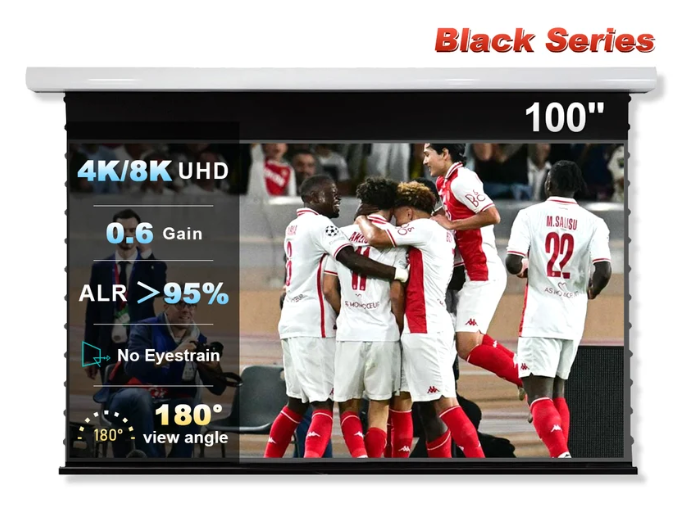
Lenticular/black-grid and Fresnel materials can both be useful, but they differ in light behavior and viewing flexibility. Screen gain, ambient-light rejection and viewing angle should be interpreted together rather than ranked as isolated numbers.
Step 6: verify installation and service
For a large motorized screen, warranty, shipping, return handling, replacement parts and controls matter. It is easier to research those before ordering than after a 120-inch cassette is already in your home.
Frequently asked questions
What should I choose first: screen or projector?
Treat them as a system. If you already own the projector, its throw geometry and placement become hard constraints for the screen.
Is a motorized screen less flat than a fixed frame?
A fixed frame is mechanically simple, while motorized models rely on tension systems to maintain flatness. Quality and setup matter.
What is the single biggest compatibility mistake?
Buying a directional ALR screen that does not match the projector's throw geometry or orientation.
Research note
Product-specific facts on this page were checked against the NothingProjector product listing and related manufacturer listings on September 16, 2026. Where we discuss fit, trade-offs or room design, that is editorial analysis rather than a claim of hands-on testing. Live merchant details can change.