Alternative 1: fixed-frame UST ALR
Choose this route when the screen can live on the wall permanently. Fixed frames are mechanically simple and naturally maintain a flat surface. The trade-off is visual permanence: a 100- or 120-inch rectangle becomes a dominant part of the room.
Alternative 2: motorized floor-rising ALR
A floor-rising screen hides in a low cabinet or housing and rises upward. It can be a strong choice for renters or rooms where wall/ceiling mounting is undesirable. It also changes the geometry and furniture plan because the cassette has to live below the image.
Alternative 3: another tab-tensioned drop-down screen
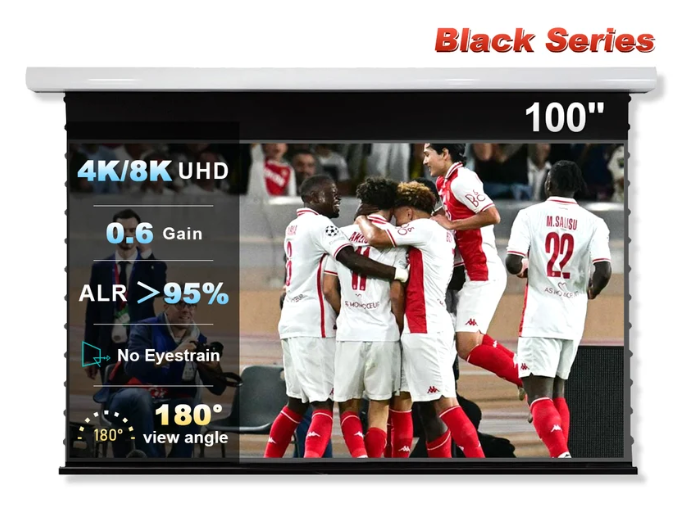
This keeps the same basic architectural idea as the NothingProjector: overhead cassette, powered deployment and side tension. Compare the actual optical orientation, cassette dimensions, motor controls, warranty, shipping and support rather than assuming all drop-down screens are equivalent.
Alternative 4: skip ALR in a dark room
If you watch almost exclusively in a well-controlled dark theater, a conventional matte screen can be a legitimate alternative. ALR is most valuable when unwanted room light is a recurring part of the viewing environment. Buying it automatically can add cost without solving a real problem.
Frequently asked questions
What is the simplest alternative?
A fixed-frame screen is mechanically simpler if a permanent screen suits the room.
What is best when you cannot ceiling-mount?
A floor-rising screen can avoid ceiling installation, provided the room layout can accommodate the base.
Is ALR mandatory for every UST?
No. A dedicated UST ALR/CLR surface is especially useful in ambient light, but a controlled dark room can work with other screen types.
Research note
Product-specific facts on this page were checked against the NothingProjector product listing and related manufacturer listings on September 16, 2026. Where we discuss fit, trade-offs or room design, that is editorial analysis rather than a claim of hands-on testing. Live merchant details can change.